What Does a Full-Stack AI Agency for D2C Actually Do?
What Does a Full-Stack AI Agency for D2C Actually Do?
A full-stack AI agency for D2C runs creative, catalog, and performance ops 24/7. Here is exactly what that looks like, with real pricing and real outcomes.
Direct Answer
A full-stack AI agency for D2C brands handles every brand operation, including creative production, catalog management, performance marketing, email, and SEO, using a combination of AI agents and human experts. It is not a software subscription or a single-channel service. It replaces the entire agency stack: creative, performance, retention, and catalog, under one squad with one invoice and one outcome owner. ShopOS delivers this model starting at Rs3L/month for Indian D2C brands.
What Operations Does a Full-Stack AI Agency Actually Cover?
A full-stack AI agency covers creative production, product catalog, performance marketing, email and CRM, and AI search visibility, all simultaneously. Each function runs through dedicated AI agents guided by human experts, not handed off to separate vendors.
Most D2C brands run four to six separate agencies at once: a creative agency, a performance agency, an email retainer, and a catalog team. Each one billing independently, each one working from a different brief, and none of them talking to each other. The coordination cost alone, covering 14 Slack messages, a wrong banner, and a dropped deadline, can erase a day of productivity and 40% of ROAS in a single week.
A full-stack AI agency collapses that stack. At ShopOS, the squad model assigns a dedicated Account Manager, Squad Lead, and Associate alongside AI agents that run specific functions. Monica handles social content, ad creatives, and brand assets. Richard manages Shopify store health, PDP copy, and catalog tagging. Gavin audits ROAS, flags creative fatigue, and runs audience strategy. Dinesh runs Klaviyo segmentation, campaign sequences, and deliverability. Big Head monitors AI search visibility and competitor citations.
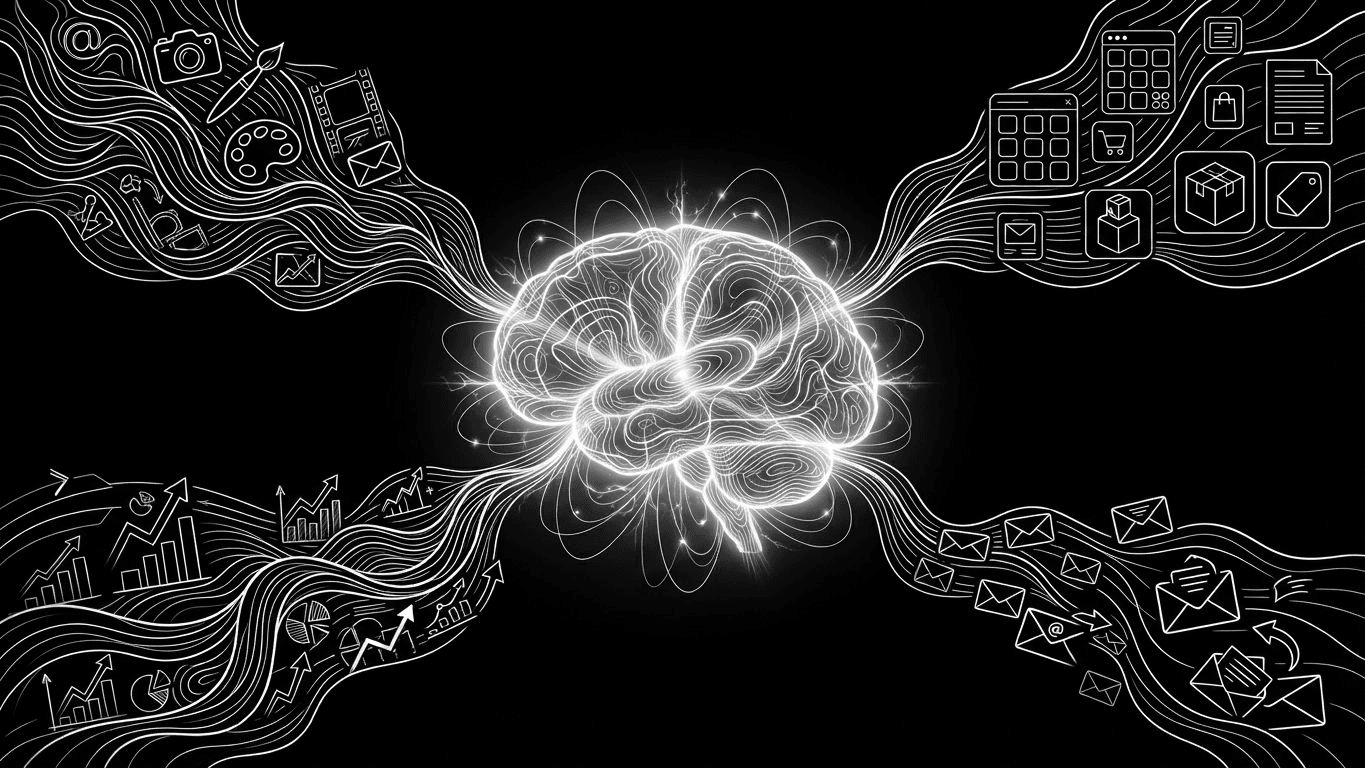
These agents do not work in silos. They share Brand Memory, a living context graph that stores voice, catalog data, audience signals, performance history, and decision traces. Every agent pulls from the same source of truth.
The four ops pillars a full-stack AI agency covers:
- Creative ops: ad creatives, lookbooks, social content, and video produced by Monica using Spaces like Fashion Studio, Product Scenery, and HD Boost
- Catalog ops: PDP copy, product tagging, launch prep, and store health owned by Richard
- Performance ops: Meta and Google campaign QA, ROAS audits, and creative fatigue detection run by Gavin
- Retention ops: Klaviyo audits, segmentation, and email sequences executed by Dinesh
📊 Brands running a fragmented agency stack spend approximately $15,000/month across creative, performance, email, and catalog services combined. ShopOS internal benchmark, 2026.
"A full-stack AI agency does not add more vendors. It replaces them, and replaces them with a squad that shares memory, not just a Slack channel."
How Is This Different From Hiring an AI Tool or a Single Agency?
AI tools generate. Single-channel agencies execute in one lane. A full-stack AI agency does both across every channel and compounds over time because it retains brand context. That retained context is the structural advantage no standalone tool or agency can replicate.
Shopify Sidekick is blind to your Meta ROAS and your Klaviyo segments. Meta's AI operates inside Meta. Google's Gemini operates inside DV360. Each platform's AI knows only its own data. None of them know your brand.
ShopOS's wedge is Brand Memory. It is the only intelligence layer connecting creative output, catalog data, performance signals, and audience behavior simultaneously across all channels. When Gavin flags creative fatigue in a Meta campaign, Monica already has the brand voice context to generate replacement creatives without a new brief. When Richard updates a PDP for a new collection, Dinesh already knows the segmentation logic to build the launch email sequence. This is not coordination. It is compounding.
By month three, the agents know the catalog. They know which creative formats perform for which audience. They know the seasonal patterns. The switching cost rises, not because of a contract, but because the memory is real and it belongs to the brand.
What separates a full-stack AI agency from tools and single-channel agencies:
- Brand Memory retains voice, catalog, performance history, and audience data across every agent
- Loops runs 50 to 500 ad variant tests in closed feedback cycles: generate, deploy, test, measure, and repeat
- Night Shift agents optimize bids and monitor performance at 2am IST while the team sleeps
- All channels, including Shopify, Meta, Klaviyo, and Google, connected in one workspace through Connectors
📊 A fashion and apparel brand using ShopOS achieved 40% faster campaign turnaround compared to their prior agency workflow. ShopOS case study, 2026.
"In a world where every brand can generate content, the brand that learns and retains context wins. Brand Memory is what makes that possible."
What Does a Real Engagement Look Like and What Does It Cost?
ShopOS's Managed Squad starts at Rs3L/month for catalog and creative ops, scaling to Rs10L/month for full-stack operations including performance marketing. Self-serve AI plans start at $19/month on monthly billing. The pricing is not a discount. It is a structural cost reduction.
Rahul Gupta, Global VP and Head at Tower, describes the model plainly: "ShopOS has been our AI design partner since the early days of launching Tower in India. They have functioned like an extended creative team, covering catalog imagery, social visuals, and high-performance ad videos." Ranjit Babu, CEO of Hardlines, puts it differently: "From generating dynamic influencer and UGC content to whipping up infographics in minutes, they have taken our product pages and social media to the next level. It is fast, it is creative."
These are not tool reviews. These are outcomes from a squad that replaced multiple vendors under one invoice. The CFO math is not subtle. Rs75L/year on fragmented agencies and tools versus Rs5L/year on a squad that produces more, retains context, and runs 24/7. That is not a feature comparison. That is a business decision.
Full pricing breakdown:
- Free: $0/month. 500 credits, one Brand Memory, 30-day trial.
- Pro: $19/month or $15/month billed annually at $150/year. AI Refinement, Connectors, Batch, two Brand Memories.
- Plus: $49/month or $39/month billed annually at $468/year. Five Brand Memories, two-user workspace.
- Growth: $99/month or $79/month billed annually at $948/year. 14,000 shared credits, Priority Support, four-user workspace.
- Business: $199/month or $159/month billed annually at $1,908/year. Human Refinement, ten-user workspace, 35,000 credits.
- Enterprise: Custom pricing. Unlimited credits, custom Brand Memory configurations.
- Managed Starter Squad: Rs3L/month. Catalog ops, creative production, and Brand Memory setup.
- Managed Growth Squad: Rs5L/month. Adds Gavin-led performance marketing across Meta and Google.
- Full Stack Squad: Rs10L/month. All ops end-to-end with a dedicated squad and AI agents.
📊 Satyen Momaya, CEO of Celio, confirmed that ShopOS's AI solutions helped streamline operations and improve efficiency across the board. Celio is a ShopOS design partner. ShopOS testimonial, 2026.
"One squad. One invoice. One outcome owner. That is the full-stack AI agency model, and it is the only model that compounds instead of invoicing."
What Features Do You Get on Each Plan?
Not all features are available on every plan. Here is a quick reference before you choose.
| Feature | Free | Pro | Plus | Growth | Business | Enterprise |
|---|---|---|---|---|---|---|
| Brand Memory | Basic | Full | Full | Full | Full | Full + Custom |
| Cowork Access | Yes | Yes | Yes | Yes | Yes | Yes |
| Images | Yes | Yes | Yes | Yes | Yes | Yes |
| Videos | Yes | Yes | Yes | Yes | Yes | Yes |
| Image Edit | Yes | Yes | Yes | Yes | Yes | Yes |
| AI Refine | No | Yes | Yes | Yes | Yes | Yes |
| Human Refinement | No | No | Yes | Yes | Yes | Yes |
| Workspace | No | No | Yes | Yes | Yes | Yes |
| Connectors | No | Yes | Yes | Yes | Yes | Yes |
| Batch Generation | No | Yes | Yes | Yes | Yes | Yes |
| Custom Model Routing | No | No | No | No | Yes | Yes |
| Priority Support | No | No | Yes | Yes | Yes | Yes |
All five agent functions, Monica, Richard, Gavin, Dinesh, and Big Head, are accessible from the Free plan. Connectors, which allow agents to read live data from Shopify, Meta, Klaviyo, and Google Ads simultaneously, unlock at Pro. Human Refinement, where a squad lead reviews agent outputs before they go live, unlocks at Business. Annual billing saves roughly 20% across all paid plans. You can switch between monthly and yearly billing at any time.
Frequently Asked Questions
What is a full-stack AI agency for D2C brands?
A full-stack AI agency for D2C brands runs all brand operations, including creative, catalog, performance marketing, and email, using AI agents paired with human experts. It replaces multiple single-channel agencies with one integrated squad that shares brand context through a unified memory layer.
How much does a full-stack AI agency cost compared to traditional agencies?
Traditional agencies cost D2C brands approximately $15,000/month across creative, performance, email, and catalog services. ShopOS's Managed Squad starts at Rs3L/month and scales to Rs10L/month for full-stack operations, replacing the entire agency stack.
What AI agents does ShopOS use to run brand operations?
ShopOS deploys Monica for creative and ad production, Richard for Shopify catalog and store management, Gavin for performance marketing and ROAS audits, Dinesh for email and CRM, and Big Head for AI search visibility. All agents share Brand Memory for unified context.
Can a full-stack AI agency replace a performance marketing agency?
Yes. ShopOS's Growth Squad and Full Stack Squad include dedicated performance operations through the Gavin agent, covering ROAS audits, creative fatigue detection, audience strategy, and campaign QA across Meta and Google Ads connected via Connectors in a single workspace.
What makes ShopOS different from using individual AI tools for D2C?
Individual AI tools operate in one channel and retain no brand context. ShopOS connects all channels through Brand Memory, a living context graph storing voice, catalog, performance history, and audience data. Every agent pulls from the same source so outputs compound instead of repeat.
Can I try ShopOS before committing to a paid plan?
Yes. The Free plan gives you up to 30 days to explore the platform with 500 credits and access to all five AI agents, no credit card required. Connectors, which allow agents to read live data from all four channels simultaneously, unlock from the Pro plan. You can upgrade or cancel at any time.