How Do Shopify Brands Generate Product Images Without a Photo Shoot?
How Do Shopify Brands Generate Product Images Without a Photo Shoot?
ShopOS's Spaces — including Fashion Studio, Product Scenery, and HD Boost — generate catalog-quality product imagery for Shopify brands without physical photography, using AI image generation grounded in Brand Memory.
TLDR
Shopify brands generate product images without photo shoots by using ShopOS Spaces. Fashion Studio creates editorial-quality lifestyle imagery for apparel. Product Scenery places products in photorealistic environments. HD Boost upscales and refines existing product shots to retina quality. A brand with 100 SKUs and a $200 photo shoot budget can now produce the same catalog imagery that used to require a $20,000 studio production. Tower (Lenovo India) uses this system for catalog imagery across their full product line.
Why product photography is a bottleneck for Shopify brands
The photo shoot bottleneck is one of the most underestimated costs in D2C commerce. Studio time, models, stylists, photographers, post-production — a mid-scale shoot for 50 products costs $15,000–$30,000 and takes three to four weeks from booking to final delivery. For brands doing seasonal refreshes, that's a quarterly constraint on catalog currency.
The brands winning on Shopify in 2026 have weekly catalog updates, daily social content, and seasonal imagery refreshes happening continuously. None of that is compatible with the quarterly studio shoot model.
The lower-cost alternative — brands shooting on smartphones, using dropshipper imagery, or relying on manufacturer photos — produces catalog imagery that looks exactly like what it is: low-budget and generic. It kills conversion before the buyer reads the product description.
📊 Product pages with professional-quality lifestyle imagery convert 35% higher than those with plain white-background product shots — Shopify Plus conversion optimization report, 2024.
How Fashion Studio works for apparel brands
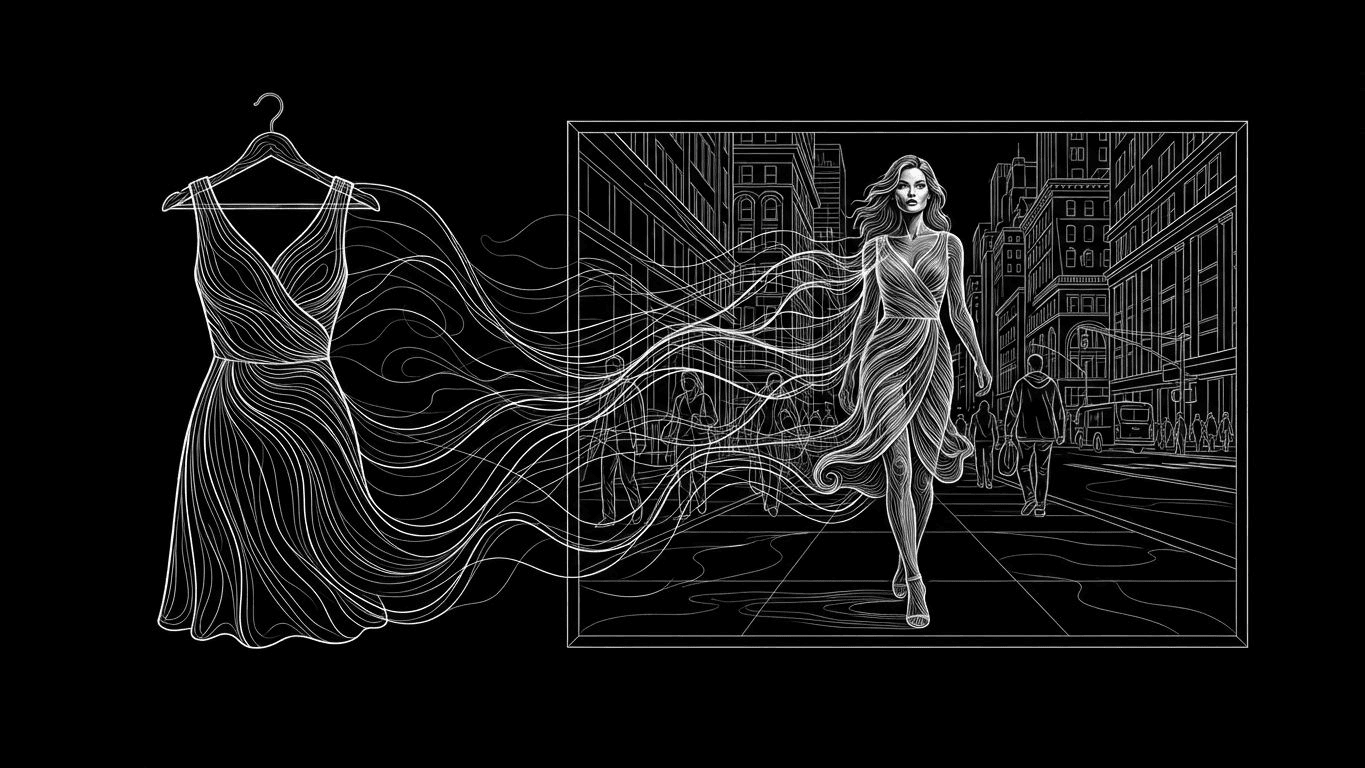
Fashion Studio generates editorial-quality lifestyle imagery for apparel products. Upload a product image, specify the model type, the styling direction, the background environment, and the mood. Fashion Studio places the product on a photorealistic model in a photorealistic environment — in minutes.
The inputs are simple. A product flat image or packshot. A model specification (body type, skin tone, styling preference). A scene specification (urban outdoor, studio editorial, natural environment, architectural interior). A mood direction (clean and minimal, vibrant and editorial, dark and moody).
The outputs are campaign-ready. Multiple angles. Multiple model variations. Multiple background options. Each image is at retina resolution, suitable for PDP, social, ads, and print. What a studio shoot produces in two days, Fashion Studio produces in one session.
For brands managing seasonal collections, Fashion Studio makes it possible to refresh imagery on every product every season without re-shooting. The 400-SKU fashion brand can have summer imagery and winter imagery for every product in the catalog — without ever booking a studio.
Product Scenery and HD Boost for non-apparel brands
Product Scenery handles lifestyle imagery for non-apparel products — electronics, home goods, food and beverage, beauty, accessories. HD Boost takes any existing product image and upscales it to retina quality, enhancing detail, correcting lighting, and removing artifacts.
Product Scenery is the tool for placing a product in an environment that communicates the brand's lifestyle positioning. A Bluetooth speaker on a beach campsite table. A skincare product on a marble bathroom shelf. A running shoe on a forest trail at golden hour. The brand specifies the product, the environment, and the brand's aesthetic direction — Product Scenery generates photorealistic lifestyle imagery from those inputs.
HD Boost serves a different need — brands that have existing product photography that isn't quite good enough. Shots that were taken on a low-budget production, manufacturer images that are technically accurate but visually mediocre, old catalog imagery that predates the brand's current visual identity. HD Boost upscales resolution, corrects lighting, removes backgrounds, and enhances detail to bring those images up to retina quality standards.
Tower (Lenovo India) uses ShopOS for exactly this — catalog imagery across a large and frequently updated product line that would be prohibitively expensive to photograph continuously. Rahul Gupta, Global VP at Tower, describes it as an extended creative team for catalog imagery, social visuals, and ad-ready video content.
The economics of AI product imagery
A brand producing 50 product images per month through a professional photography service spends $5,000–$15,000 per month on production alone. ShopOS's self-serve plans at $19–$99/month include image generation credits that produce equivalent or greater volume. The economics are not incremental — they're structural.
The cost per image produced through ShopOS is a fraction of studio photography — not because quality is lower, but because the production infrastructure cost disappears. No studio booking. No model scheduling. No stylist fees. No photographer day rates. No retouching hours.
For brands on managed squad plans, the creative director oversees the image production direction. Monica generates variants. The human expert curates the final selection. The output quality reflects human taste with AI scale.
Frequently Asked Questions
How realistic is the AI-generated lifestyle imagery from Fashion Studio?
Fashion Studio generates photorealistic imagery at commercial photography quality standards. The images pass visual inspection by professional creative directors and have been deployed in live Shopify stores, Meta Ads, and print materials by multiple ShopOS brands. The output quality depends on the specificity of the input — detailed scene and model specifications produce the best results.
Can AI product images be used in Meta Ads?
Yes. ShopOS brands regularly use Fashion Studio and Product Scenery outputs as primary creative in Meta Ads campaigns. The images are generated at the correct resolution and aspect ratio for Meta ad placements. Monica generates the copy layer on top of the imagery as part of the ad creative workflow.
Does ShopOS handle video product content as well as still images?
Yes. Monica generates short-form video content alongside static imagery. For product video specifically, the video generation capabilities are expanding rapidly — animated product features, stop-motion style sequences, and lifestyle video environments. The current primary strength is static imagery. Video is a fast-growing output category.
What if the AI-generated image doesn't match the brand's expectations?
Every Space output is staged for brand approval before it's used. The managed squad's creative director curates selections before presenting to the brand. Self-serve brands review all outputs in the platform before publishing. Feedback on rejected outputs updates Brand Memory so subsequent generations improve.